International Humanitarian Law
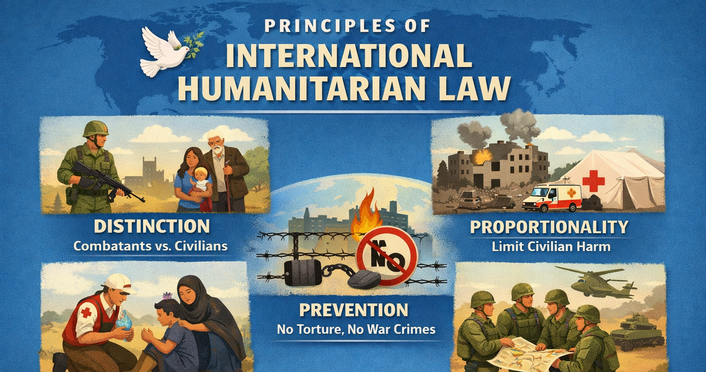
Principles in International Humanitarian Law
The rules that make up the international humanitarian law (IHL) are all centered at regulating conflict with an aim of minimizing the human suffering. It therefore tries to balance the military necessities that often arise with the needs for humanitarian protection. International Humanitarian Law is founded upon six basic principles that govern the conflict regulation at both the state and international level. Each principle is bounded within specific rules and norms whereby they help in the interpretation of the law when controversial matters arise within the governments. This section will discuss exhaustively the principles on which International Humanitarian Law is founded (ICRC, 2016).
Principle of Distinction between Civilians and the Combatants in International Humanitarian Law
The first principle is that of distinction between civilians and the combatants. This is a principle that tends to differentiate between the civilians and the combatant. Writers who offer constitutional law assignment help at Edudorm essay writing service notes that the military force is only allowed to attack combatants such as criminals, terrorists or any other form of enemies. Any direct attacks that are done by the military forces upon the civilians is considered as a crime attack as penned down in Article 48 and 52 of Additional Protocol 1 to the Geneva Conventions (ICRC, 2016).
Principle That Prohibits Attacks against Those Hors De Combat
The next principle prohibits attacks against those hors de combat. These are people who are either sick, wounded or prisoners of war. It is actually a fundamental rule which protects the harmless from being attacked. Closely related to this is the principle that prohibits infliction of unnecessary suffering. The International Humanitarian Law provides a protection even to those who are lawfully attacked such that superfluous injury should not be crowned by an attack. One of the rules that fall under this principle is the prohibition of using blinding laser weapons (ICRC, 2016).
Principle of Proportionality in International Humanitarian Law
Next is the principle of proportionality. Under Article 51(5) (b) of API, the civilians have been protected against excessive hostilities from the military bodies. Experts who offer law assignment help services at Edudorm indicates that it rather demands that the least possible harm should be caused to the civilians with respect to the proportionality of the military advantage.
The Notion of Necessity Principle in International Humanitarian Law
The notion of necessity is the other International Humanitarian Law principle that is often clashes with the humanitarian protection. It allows the military bodies to fully take a destructive move regardless of the consequences that may arise as a result. This is however required when necessity demands such that full exertion is the only option. The military is required to interpret and understand the other principles of humanitarian protection hence implying that they are not supposed to ignore any of the principles (ICRC, 2016).
Principle of Humanity in International Humanitarian Law
Lastly is the principle of humanity. This is a principle that basically stipulates the fact that all human beings have the capacity to respect and care for others even the adjacent enemies. Authors who offer law essay help at Edudorm essay writing service points that the notion argues that humans and animals are made difference by this principle such that respecting life is a mandatory obligation for everyone around the globe.
Conclusion
Asymmetric warfare is conflicts where the warring parties significantly differ in strength. In most cases such warfare is not prone to breaking the International Humanitarian Law principles because the decision to follow is in the hands of the stronger party. In this case, the stronger military force is directly held accountable of any irresponsible attack and therefore a clear expectation is outlined. In addition to this, the asymmetrical warfare is friendly enough to remind the stronger army that regulation is part of its requirement. Failure to comply with the IHL rules and principles would hold the militant responsible of any irresponsible attack.
References
ICRC. (2016). Practice Relating to Rule 1. The Principle of Distinction between Civilians and Combatants.