Vertigo Film Analysis Essay
Voyeurism in Vertigo Film
In the Vertigo film, Scottie is the watcher as he has been employed by Elster to follow his wife, Madeleine, around to find out what she is up to. The Voyeurism used in the film is important as it is how Hitchcock uses it to show the relationship that exists between the cinematic image and the cinematic spectator (Hitchcock 1). Scottie is often shown when following Madeleine from a far. He is often in the shadows while the woman he is following is well illuminated to emphasize on who is observing and who is being watched. Since Scottie ends up getting emotionally attached to the person he is watching, Hitchcock may have intended to suggest that viewers get attached to the Vertigo film as well.
Fetishization in Vertigo Film
This is evident from the first scene which is full of drawings of women’s fashion. In the scene, Scottie and Midge hold a bra and are engaged in a conversation discussing it. Writers who offer English homework help at Edudorm essay writing service notes that the bra symbolizes the part of the female anatomy that most men are attracted to. Since the bra is designed by a man, it shows what men prefer when it comes to a woman breasts as is shown by the bra. There is also the scene where Scottie follows Madeleine and eventually ends up admiring and getting emotionally attached to her (Hitchcock 1).
Auteurist traits in Vertigo Film
There are various traits that are common in both Vertigo and North by North west such as the shots used in the films. Hitchcock uses odd angles that are skewed and wide sweeping shots which often lead to tight close ups. He also uses color very well and combines it with long sequences that have little or no dialogue (Hitchcock 1). Another similarity is the use of the MacGuffin where Hitchcock incites desire and curiosity from the audience to motivate the actions that the characters will engage in and drive the plot of the story. The specific identity of the MacGuffin however remains unimportant in the plot. In Vertigo, Valdes is used as a MacGuffin because the details surrounding her death are not important and the viewer is drawn to focusing on how she possessed Madeleine. In North by North West, the MacGuffin is seen where Richard Thornhill runs for his life across the country but the viewer is not informed why (Hitchcock 1).
Visual styles and mortifs
Visual styles are used in the Vertigo film often with hidden meanings for the viewer to deduce. Corridors and tunnels for example are used often to represent the passage that characters go through to death. The first tunnel is seen the camera focuses on the perspective that Scottie has when he is hanging on the gutter from the rooftop (Hitchcock 1). Experts who offer English homework help at Edudorm essay writing service indicates that a tunnel effect is created when the camera focuses straight down the building. Spirals are also used to provoke the feeling of vertigo that haunts Madeline and Scottie. In the opening scene, a spiral comes from the eyes of a woman and another case where Scottie looks down to his colleague who has fallen and the limbs of the dead man are in a spiral shape.
Neuroses and hysteria
At the beginning of the Vertigo film is a shot of a woman which starts of as a close up shot and gradually pans to her eyes. At this point, the screen turns red, the music playing in the background hits climax and as the shot is focused more on the woman’s eyes. The shot reveals that the woman is afraid but it is unable to identify what she is afraid of. Her mouth reveals her attempt to move her lips to maybe scream or cry for help but she is unable to (Hitchcock 1).
James Stewart and Kim Novak in Vertigo Film
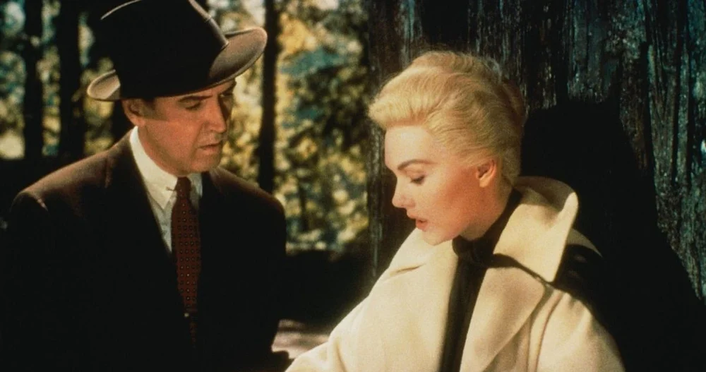
The two characters are used by Hitchcock to portray that stereotypes that existed regarding men and women in that time. Stewart is used as a masculine figure whose body is intended to show that men were strong and well built. He is presented as being capable of handling himself and takes care of events occurring around him. Novak on the other hand is portrayed as weak and needs the help of a man. Her body is used to seduce Scottie and also the audience. She is portrayed as being weak because she decides to commit suicide (Hitchcock 1).
Work cited
Hitchcock, A. “Vertigo.” 1958.