Native American Boarding Schools
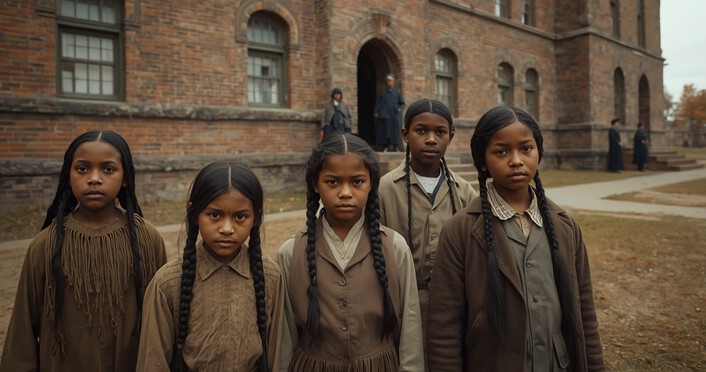
Native American Boarding Schools and the Achievement of the Native Children Assimilation into the Society
Native American boarding schools in the United States occurred during the late 19th and the early 20th centuries to provide education to Native American youths and children based on Euro-American principles[1]. The schools were founded by missionaries Christians from different denominations who started the schools mainly on denominations and Native American boarding schools were founded to offer chances for children whose location was not exposed to any nearby school particularly in areas which were lightly populated on the west. Writers who offer coursework help at Edudorm essay writing service notes that religious societies were paid by the government to offer education to the children of Native Americans on reservations. On the basis of the assimilation approach of Carlisle Indian Industrial School the Indian affairs bureau more Native American boarding schools were founded in the same period[2].
The Significance of Native American Boarding Schools
Native American boarding schools were ultimate instrument for the absorption of individuals and beliefs that hindered the destiny manifestation. The schools would be able to quickly be able to assimilate the Native children[3]. The first priority of the schools was to offer essentials of academic learning which included writing, reading and speaking the English language. Science, history, arts and arithmetic were also added to increases the potential of discovering the self-guided thought power that would lead to the individualization of the Native Indians. With religious training being conducted in a christen way and the retching of a democratic society’s principles, political structures and institutions the perception of citizenship was being changed. The end objective was to eliminate all the Native cultures vestiges[4].
Prior to the 1880s, the United States was operating approximately 60 schools for more than six thousand students that included both reserved day and Native American boarding schools [5]. The reserved day school were more advantageous since they were a bit inexpensive and caused less objection from parents. On the other hand, the reservation boarding’s utilized half of the learning days teaching English as a language as well as academics and the rest of the day was utilized on industrial training. Experts who offer custom coursework writing help at Edudorm essay writing service indicates that regimentation was the day’s order and the Native children spent much hours going to and from class, acquiring meals and the dormitories. The children were taught order, self-restraint and discipline which were some of the high values in the American white’s society[6].
The Native American boarding schools were mainly working on the hope of producing students who were economically self-adequate by training work qualities and the instillation of beliefs and values of possessive individualism which implied that persons were entitled to making person decisions based on their interests without necessarily depending on societal norms. This was an opposition of the Native beliefs and culture which values collectivism of communal ownership meaning that ownership was for all persons. The boarding reservation schools led to the assimilation of the Native children into the larger American society. Assimilation that was achieved is the cultural one in that the children learned and began to speak English to fit into the society, most of them at the period become Christians since religion taught at the schools was Christian based, they wore American style clothes, haircuts were changed to American style and most of them lived in houses styled in the American way and preferred to work in an economy that worked on the basis of cash[7].
Cultural Assimilation at Native American Boarding Schools
Cultural assimilation was achieved since children got immersed in the euro-American culture through haircuts changes, the replacement of their traditional names by fresh Euro-American names which were both termed as civilized and based on Christianity and the forbidding of Native languages speaking[8]. The separation of the children from their families implied that they were being assimilated in different ways since they were separated by culture, language as well as geography. In that, in several ways, children were mainly encouraged or pressured to dump their Native American cultures and identities. The primary goal of establishing the schools as the main reform was to utilize education as an instrument of assimilation. The Native tribes would then be assimilated into the large American society and the American way of living through adopting the American customs, styles, language and standards[9].
Off reservation Native American boarding schools implemented their assault on the cultural identity of Natives by eliminating the external experience of Native values that the children carried. This began with the change of hair style where the long Indian boys’ braids were cut off to fit in the American style. Tutors who offer coursework writing help at Edudorm essay writing service acknowledges that the Native children were offered fresh names which included surnames based on the assumption that this would be of assistance when they inherited properties. This created fresh beliefs in regard to ownership which was a form of assimilation. Native traditional foods were abandoned which pressured the children in fully adopting the white’s society food options and rites which included the use of spoons, forks, knives, tablecloths and napkins[10]. Children were highly encouraged to communicate in English by forbidding the use of Native languages in any communication. Those that were able to stick to English communication were awarded but most of the schools depended on punishment for those who broke the order[11].
At the developed off reservation Native American boarding schools, students held the opportunity of attaining English literacy degree in a very short period. The teaching of history was based on definite fair bias. Majority of the wok in the schools was accomplished by students since the schools were highly objected on creating self-sufficient and the activities involved in industrial training created the thought that the Natives held the ability of competing economically with the whites. The assimilation was effective since the Native Indians began to compete economically with the whites which is evident even in the modern society[12].
Christianity conversion was considered to be important to the foundation of the Native American boarding schools. The schools were obligated to create an instructional plan that made high emphasis on Christianity which was objected at implantation of sin ideas and the feeling of guiltiness which pressured most of the to convert[13]. Gender relations and all the relations were governed in a Christian way which means that both genders were kept separate in most cases. Indian schools boarding made discipline to be a severe standard which resulted in confinement, privileges deprivation, corporal punishment and restrictions. Native American boarding schools were viewed as the complete destruction of Indian cultures and that was the pure intention and the main objection was made since the system destroyed the relation amid the parents and the children. Naturally the schools were highly refuted by parents and when they refused to enroll their children, they were acquired by police forces. In most cases the less fortunate are the ones that filled the vacancies based on their less privileges and also those that were impaired physically.
Native parents ganged together in order to get their children out of the off-reservation schools by encouraging the children to run away and even undermining the standards and the influences of those schools during breaks and summer periods. The ruling of the court in the year 1893 raised the pressure of keeping Native children in the off-reservation schools. The learning and the assimilation continued until the year 1978 when the Indian Child Welfare Act was passed. The policy allowed the Native American parents to gain the legal rights of denying the children placement of off-reservation Native American boarding schools.
The educators that were being paid by the government felt that the most suitable way was offering Indians assimilation of focusing on children. This meant that the children had to be removed from their homes which created greater influences in regard to language, religion as well as community by placing them in off reservation schools which were being operated by obvious greater Americans who worked in ensuring that assimilation was achieved. Authors who write my coursework at Edudorm essay writing service points that this was the primary pedagogical and philosophical basis of the Native American boarding schools. Because the federal government and even the American people did not want to utilize much in the Native education, the off-reservation schools were expected to be comparatively self-adequate. Under the industrial education semblance students mainly served as a pool of unpaid workers in provision of cooking, cleaning, sewing, dairying, farming as well as other services. Because the American professions that provided training believed that character would be shaped through hard work, they were fully justified for not giving any kind of payment to the students[14].
The Primary Intention of Native Boarding Institutions
The primary intention of Native boarding institutions was to destroy tribal values and identity. In the schools’ children were able to acquire racial awareness[15]. American society was perceived as racist since the Native society was being viewed as a single and a minor group rather than some hundreds cultural entities since the Natives were comprised of different cultures. The Native American boarding schools in the period were considering themselves as Indian racial groups which raised the awareness of what races were. Most individuals would believe that the Indian students adapted easily to the American life and standards which was not the actual case. The fact that most of the schools comprised of commentaries for the students that died in the process and jails for the rebellious group demonstrates that the assimilation was not acquired easily[16].
Conclusion
It is clear that the Native American boarding schools were objected at creating cultural assimilation through the adoption of the Euro-American standards, Christian religion as well as English as a language. The schools ensured that the speaking of Native languages, their practices such of that of haircuts and dressing were completely abandoned by the institution of strict policies and the reliant on punishment. Assimilation of the Native children was partially achieved since most of them adopted different American values such as language and economic focus. The schools achieved assimilation through creating more American based perspectives such as those regarding economic competition and individualism.
Works Cited
Littlefield, Holly. Children of the Indian Boarding Schools. Minneapolis: Carol Rhoda Books, 2001. Print.
Trifler, Clifford E, Jean A. Keller, and Lorene Sisquoc. Boarding School Blues: Revisiting American Indian Educational Experiences. Lincoln: University of Nebraska Press, 2006. Internet resource.
Olson, James S, and Raymond Wilson. Native Americans in the Twentieth Century. Provo, Utah: Brigham Young Univ. Press, 1983. Print
Stout, Mary. Native American Boarding Schools. Santa Barbara: Greenwood, 2012. Print.
[1] Olson, James S, and Raymond Wilson. Native Americans in the Twentieth Century. (Provo, Utah: Brigham Young Univ. Press, 1983), 84.
[2] Olson, James S, and Raymond Wilson. Native Americans in the Twentieth Century. (Provo, Utah: Brigham Young Univ. Press, 1983), 84.
[3] Stout, Mary. Native American Boarding Schools. (Santa Barbara: Greenwood, 2012), 27.
[4] Olson, James S, and Raymond Wilson. Native Americans in the Twentieth Century. (Provo, Utah: Brigham Young Univ. Press, 1983), 84.
[5] Stout, Mary. Native American Boarding Schools. (Santa Barbara: Greenwood, 2012), 27.
[6] Littlefield, Holly. Children of the Indian Boarding Schools. (Minneapolis: Carol Rhoda Books, 2001). 13
[7] Stout, Mary. Native American Boarding Schools. (Santa Barbara: Greenwood, 2012), 27.
[8] Olson, James S, and Raymond Wilson. Native Americans in the Twentieth Century. (Provo, Utah: Brigham Young Univ. Press, 1983), 84.
[9] Olson, James S, and Raymond Wilson. Native Americans in the Twentieth Century. (Provo, Utah: Brigham Young Univ. Press, 1983), 84.
[10] Littlefield, Holly. Children of the Indian Boarding Schools. (Minneapolis: Carolrhoda Books, 2001). 15
[11] Stout, Mary. Native American Boarding Schools. (Santa Barbara: Greenwood, 2012), 27.
[12] Littlefield, Holly. Children of the Indian Boarding Schools. (Minneapolis: Carolrhoda Books, 2001). 13
[13] Olson, James S, and Raymond Wilson. Native Americans in the Twentieth Century. (Provo, Utah: Brigham Young Univ. Press, 1983), 84.
[14] Stout, Mary. Native American Boarding Schools. (Santa Barbara: Greenwood, 2012), 27.
[15] Trafzer, Clifford E, Jean A. Keller, and Lorene Sisquoc. Boarding School Blues: Revisiting American Indian Educational Experiences. (Lincoln: University of Nebraska Press, 2006).3.
[16] Trafzer, Clifford E, Jean A. Keller, and Lorene Sisquoc. Boarding School Blues: Revisiting American Indian Educational Experiences. (Lincoln: University of Nebraska Press, 2006).3.