
EduCap Company Scandal
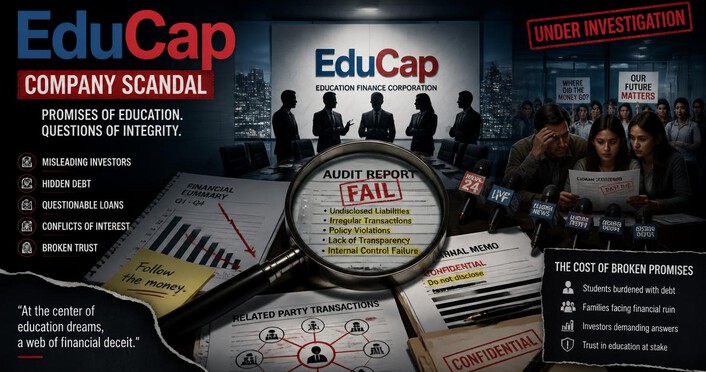
THE CHRONICLE OF HIGHER EDUCATION NEWSPAPER: EduCap Company, a Lender Under Investigation, Says It Will Reduce Student-Loan Operations
EduCap Company is a nonprofit organization located in Washington, D.C. It is an education finance company which was formed in 1987. It provides loan to students and loan programs to corporation and other sponsors. In 2007, news reported that EduCap Company was involved in ethics lapse by abusing the tax-exempt status by charging a high number of interests from loan offered to a student. In addition, the company offered Reynolds and her husband millions of monies as a compensation and used $31million in luxury jets (The Chronicle, 2007). Investigations showed that the company used luxury jets with families and friends and moved to different destinations where their spent their time and money with personal things which could not relate with charity mission. The news reported that Reynolds went for a trip in Europe and the Middle East where he was accompanied by Daschle and his wife. Here, they spent $8.150 with friends (The Chronicle, 2007). Writers who offer research writing help at Edudorm essay writing service notes that Ted Stevens was also involved with correctional charges and traveled to destinations like Aspen where he was accompanied by his wife and daughter. The terrible thing is that the money which was spent in extravagance came from students’ higher interests which was three time more compared with number of interests given by the government. EduCap Company executive enjoyed big salaries and spent the money with lavish retreats, bodyguards, swank resorts and other material things. Investigation also confirmed that Reynolds offered a loan of $8 million to a charitable organization managed by her husband which is known the Academy of Achievement (The Chronicle, 2007). In addition, he offered loan of $1.5 million to a company which he owns. Reviewers said that the company was not acting as a charitable organization but rather it was a for-profit organization. It was charging 18percent interest- a high amount which even for-profit companies do not charge. This company was predatory lending, and students complained of high interests’ costs and violent collection tactics (The Chronicle, 2007).
The scandalous action by EduCap Company could have been avoided if there was better effective financial management. This could improve the ethical behavior as well as public trust. Executives could not involve themselves in excessive compensation and mismanagement of finance since financial management could ensure that resources are utilized responsibly (Renz & Herman, 2016). Effective management could also ensure an institutional oversight related with transparency performance and rating system. Ethical leadership should be related with financial transparency- a key element in fostering positive culture (National Council of Nonprofits, n.d.). Experts who offer research paper help at Edudorm essay writing service indicates that through transparency, members could access the tax-exemption information. Second, this could be avoided if there was an ethical culture. With ethical culture, executives could support ethical conduct, show integrity and ethical concern in allocation of resources, public relations, compensation decisions and more. Grobman (2015) asserts that the ethical principle in ethical in ethical future states that people should treat others the way they would like to be treated. Following this rule, executives could not carry out activities which could bring a negative impact to the organization.
Third, the ethical lapse could be avoided if there was a compliance program. These programs could provide executives with ethical codes and assist them in following core values, promoting trust and avoiding legal liability and conflict of interests (Aries, 2014). Fourth, the unethical issue could be avoided by EduCap Company if there was an investment policy. Tutors who offer custom research writing service at Edudorm acknowledges that these policies could ensure that financial portfolio and values align together. Investing principles could ensure return on investment which is a key element in mission achievement. Last, the ethical lapse could have been avoided if there was whistleblower policy. Staff members in the company could use the confidential opportunity and report the unethical behaviors with executives (Renz & Herman, 2016). In order to whistleblower, staff at EduCap Company could cultivate transparency and do performance reviews based on financial data to get a vivid image of the organization’s operations. Cultivating transparency could also promote accountability and by having detailed information, staff could identify fraud and blow the whistle.
References
The Chronicle. (2007). EduCap, a Lender Under Investigation, Says It Will Reduce Student-Loan Operations. Copyright © 2017 The Chronicle of Higher Education
Renz, D. O., & Herman, R. D. (2016). The Jossey-Bass handbook of nonprofit leadership and management.
Aries, G. (2014, Nov. 1) Finding the core of an ethics program. Ethics and Compliance Initiative.
National Council of Nonprofits. (n.d.) Ethics and accountability in the nonprofit sector
Grobman, G. (2015). Chapter 1 of ethics in nonprofit organizations.