The Great Depression
The Causes of the Great Depression
The great depression was the wisest stock market crash in the history of the world. Primarily, the crash in the global market was a serious worldwide economic meltdown and depression, which occur in the 1930s[1]. Great economic depression was the deepest, longest and the most widespread crisis of the 20th century. The great depression of 1929 has remained a lesson, and an example to date and even for the generation to come on how the world economy can decline. Notably, the great depression originated from the United States because of a significant fall in the stock prices on Sept 4, 1929, and later spread worldwide on Oct 29, which marked the word’s stock market crash, and the day marked as black Tuesday. Writers who offer research writing help at Edudorm essay writing service notes that the incident destroyed economies of different cities especially those that depend on the heavy industry since the depression had severe, devastating effects on both rich and poor. The causes of this of this world economic crisis were multiple both worldwide and domestic conditions. Therefore, this paper focuses on a critical exploration of the causes of the great depression.
The Great Depression and World Worst Stock Market Crash
The causes of the world worst stock market crash ever on the surface of the earth that brought numerous devastating effects to many countries ranging from personal income, to profit, and to revenue tax were multiple, both domestic and worldwide[2]. The crisis not only brought devastating effects on trade but it untimely resulted into an enormous widespread of unemployment across the globe leaving many nations underproductive and with massive debts. Although majority believed that, the crash in the stock market in 1929 triggered the emergence of the Great Depression. Still, there were some underpinning signs of deteriorating economy because of synergetic and cumulative causes. Therefore, the stock market crash of the twentieth century begins this discussion on the causes of the great depression.
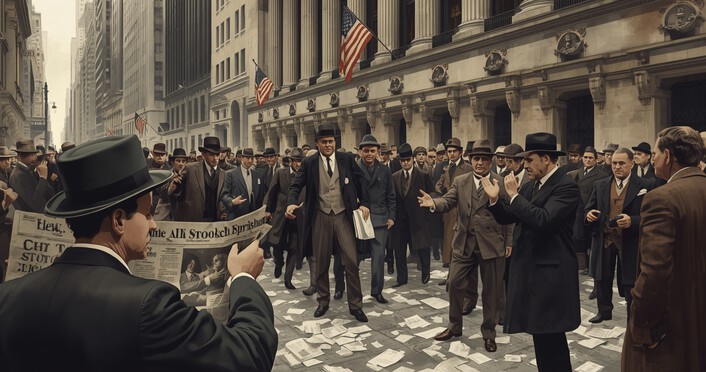
The majority of people believe erroneously that this market crash saga marked the outbreak or is more or less the same as the great depression. Following in occurrence October 29, 1929, branded as the Black Tuesday and a few days after that an eruption of the Great Depression, it is believed to be the primary cause of the World economic crisis of the 1930s. It followed that barely two months after the historic market crash; different stakeholders across the world underwent a total loss of approximately $40 billion dollars[3]. In the process, despite the attempts and efforts to restore a regain the losses, by 1930 it was inevitable to continue balancing the loss, and the profits and the entered the so-called The Great Depression.
An approximate number of 9,000 banks failed, the failure of a bank to an intuitive implication only mean the loss of people savings[4]. The people deposits were not insured then, and therefore the failure of numerous banks across the globe amounted to a massive loss of individuals saving. Experts who offer research paper writing service at Edudorm indicates that, unfortunately, as a result, the remaining and surviving banks sniffed fire and refused to give out loans instead focuses on their survival. Furthermore, the surviving banks embarked on internal management to help the few remaining banks to survive, in the process lessening expenditures, which eventually exacerbated the outbreak of the Great Depression[5].
The failure of the bank was one of the leading causes of the great depression because to cover for the high interest rates they gave to their clients as a result of the weak economy, they were to gather more income the loans in the form of interest which they stopped giving. In addition, the few surviving banks were also competing for the agricultural industry so aggressively for deposits that made them raise their interest that they failed to recover[6]. In October 1929, this with other causes a historic slide in the United States stock exchange amounting the Great Depression.
After the First World War in 1918, the Entebbe Alliance, which the United States allied with, owed enormous sums of money to the American banks. The war left the European countries devastated both socially and economically that they could not afford to settle down their form their shuttered treasuries. Consequently, pushed America to demand reparation payment from Austria-Hungary and German, unfortunately, the two countries were in severe economic trouble and could not even pay the reparation payments than the Entebbe alliance could settle their debts.
Afterward, the debtor nations defeated to pay debts and even to trade due to high tariffs of U.S. stock exchange began to weaken the American economy in 19020s. In the same year, U.S. refused the European proposal to forgiveness or reduction of debt and instead started giving loans. In the process, the debt payment was being carried out in a manner that the old ones were being augmented as new ones were created[7].
In the 1920s, the high tariffs impeded the payment of the war debts and the European demand for sound from the United States began declining due to the thriving of the home industries. The raising of taxes the American imports in 1929 damages American overproduction and income and the midst of the scramble for liquidity after the stock market crash, the weak European economy crumbled leading to the Great Depression.
In the 1920s, everything in America appeared to be running smoothly with a general appearance of economic prosperity. However, the majority of the Americans refrained from sharing their wealth equally, what historians refer to as misdistribution of wealth. [8]The practice that is characterized much by human history is used to describe a situation of an even distribution of wealth. In this scenario, the majority has a few material goods, can do nothing about their status or position verse minority having a great accumulation of wealth, and is hesitant to share with other; they only wish to keep for themselves.
During the period between 1920 to 1929 disposable income for the less fortunate rose by a small percentage of nine percent whereas for the top they realized an immense increase of close to 75 percent. The above episode contributed a great deal in widening the gap between the poor and the rich. Tutors who offer research proposal help at Edudorm essay writing service acknowledges that during the same period between 1920 and 1929, the prices of goods remained stable as the cost reduced with the increase in productivity. The scenario built a severe financial distress in the country as the government did very little condemn the misdistribution. In fact, actions after that did nothing to the condition but worsen the whole thing. His struggle in passing the tax bill in the Congress in 19020 encouraged the wealthy to retain exceedingly more of their wealth[9]. The government not only passed the bill over the same but also was against the strike and protest of workers who formed a union to avert the situation. Come the year 1929 with Wall Street crash this practice of misdistribution perpetrated the Great Depression.
As in many countries, the agrarian revolution has exacerbated the economic development united states being inclusive. Primary production is very imperative for the growth and development of the world economy as well[10]. However, the United States Agriculture shared no the economic prosperity that boomed in the 1920s. Due to the first world war of 1914 to 1918, the American farmers through the government food administrator were encouraged to increase their agricultural production. The above directive was given to farmers because their European allies’ production was widely disrupted and so there was a need that the United States being the allies provides them with the food supply. Consequently, the United States production immensely from the production of less than 690, 000 bushels of wheat annually to producing approximately 945,000 bushels of wheat per annual. In order to maintain this big supply of food, the country employed a larger workforce in to the sector in the 1920s. Unfortunately, the sector at that time relied on the income tax from the food exports to Europe.
Afterward, to make the phrase agricultural woe real, the war had ended in 1918; the European had settled back in their home countries and had started producing their food. Nevertheless, the agricultural food production in the United States remained at its peak producing approximately 800,000 bushels of wheat annually[11]. The intended market destination, which was also the financial source for the large workforce in production, was no more and stiff competition was rising from countries such as Argentina and South Africa. At the same time farmers needed to get money to purchase farm inputs and machinery.
The scenario forced the farmers to borrow money to buy the equipment and seed as most of them took a loan in early 1929. The government came in to assist the situation by involving the Congress to protect farmers from the stiff competition, but all were in vain. The incident affected the majority of the American population since primary production forms a larger percentage of the economy and by 1929, many were American were struggling desperately.
Stock speculation is to buy a stock with an assumption or an aim of selling it at a profit in future. In many circumstances, enterprises do sell their stock to accumulate money and expand in the process. Unexpectedly, only two percent of the entire American populations were purchasing stock by mid-1920s. Authors who offer research paper help at Edudorm essay writing service points that with the advancement of the American economy during the period of the world war stock prices shot and investors made a lot of money, and by mid-1920s a good number had saved money to buy stock. It seemed to the investors as an easy platform to make money though ignorant of the misleading information concerning stocks[12]. During this time, the stock prices were high, and the market was favorable for the investors to the extent that some involve brokers. Moreover, some even went to the extent of buying on a margin, meaning an investor purchasing stock even using his or her money.
Many investors and brokers then were sure of their money, and investment broker engaged the financial institutions the banks to borrow loan in order to arrive at their pre-set margin limits. The growing demand for stocks by different investors and investment brokers compelled a steady stock price increase even beyond the real stock overall worth. The situation when stock prices drastically rise is called market bull.
However, later in 1929, contrary to what was happening before, the stock prices dropped instead of rising. The investor’s efforts and money were wasted since the stock could only sell as low as $ 70 all the way for $100, which could not even settle the debt incurred from the loans. Come October 29, when there was a historic stock market meltdown, investor lacked enough money to meet or fulfill the requirement of the margin call demand by their brokers[13]. As a result, the market turned into a bear market as many investors lost their money used in different investment across the country hence causing the Great Depression of 1930.
On the other hand, holding companies also contributed to the emergence of the great depression. Owing to the unregulated structure of enterprises in America, many holding companies emerged. Explicitly, holding companies are those businesses that regulate an operating company. Therefore, since the holding companies dictate every operation in the operating companies, they offer advisory management as well as decision-making. Many of these holding companies used large chunks of money from bond sales and stocks to buy stocks in many operating companies across the nation claiming and promising that by so doing they are making soundest investment possibilities[14]. The holding companies took advantage of the growing economy and explored operating businesses in nearly all the sectors railroad to entertainment industries. The holding companies in the quest for more money formed a superior holding company to buy another holding company. With the crash of the stock market in 1929, the operating companies were an able to make a profit, there was no money for investors, and the people were unable to purchase the goods. Moreover, the many operating companies went bankrupt and therefore, could not uphold and support that administration of the holding companies leading o their collapse together with the house of cards, and in the end, this also contributed to the occurrence of the great depression[15].
In conclusion, indeed following the above discussion, it is intuitive that the emergence of the so-called The Great Depression was not a one-cause phenomenon. Several other cumulative factors contribute to its occurrence as well. The several other factors that lead to the emergence of this great word economic meltdown as discusses; one can be right to say that they were perpetuated by the occurrence of the first world war of the 1914-198. Notably, stocks being the share in the ownership of any given corporation can be termed as determinant or a sustainer of economic balance. The above deduction alludes to the fact that occurrence of the historical stock market crisis in 1929 was not only the primary cause but also the immediate trigger cause of the Great Depression. Therefore, one can conclude that the back born of both domestic and worldwide economy rest on the shoulders of the stock markets as well as the management of the financial institutions. Hence, the primary causes of the great depression are; the stock market crash of the 1929 and the bank’s failure.
Bibliography
Allen, Amy Ruth. 2014. Growing up in the great depression 1929 to 1941. Minneapolis: Lerner Publications Co. Minneapolis: Lerner Publications Co, 2014.
Eichengreen, Barry J. 2015. Hall of mirrors: the Great Depression, the great recession, and the uses-and misuses-of history. New York, NY: Oxford University Press, [2015]
Manikumar, K. A. 2003. A colonial economy in the Great Depression: Madras (1929-1937). Hyderabad: Orient Longman. Hyderabad: Orient Longman, cop. 2003.
Olson, James Stuart. 2001. Historical dictionary of the Great Depression, 1929-1940. Westport, Conn: Greenwood Press. Westport, Conn.: Greenwood Press, 2001.
Smiley, Gene. 2002. Rethinking the Great Depression. Chicago: I.R. Dee. Chicago: I.R. Dee, ©2002.
Robbins, Lionel. 2007. The great depression. Auburn, Ala: Ludwig von Mises Institute. Auburn, Ala.: Ludwig von Mises Institute, 2007.
[1] Manikumar, K. A. 2003. A colonial economy in the Great Depression: Madras (1929-1937). Hyderabad: Orient Longman Hyderabad: Orient Longman, cop. 2003, 28.
[2] Rothbard, Murray N. 1983. America’s great depression. New York City: Richardson & Snyder. New Brunswick, N.J.: Transaction Publishers, ©2009, 13.
[3] Eichengreen, Barry J. 2015. Hall of mirrors: the Great Depression, the great recession, and the uses-and misuses-of history. New York, NY: Oxford University Press, [2015], 12.
[4] Manikumar…..24
[5] Smiley, Gene. 2002. Rethinking the Great Depression. Chicago: I.R. Dee. Chicago: I.R. Dee, ©2002, 18.
[6] Robbins, Lionel. 2007. The great depression. Auburn, Ala: Ludwig von Mises Institute. Auburn, Ala.: Ludwig von Mises Institute, 2007, 21.
[7] Allen, Amy Ruth. 2014. Growing up in the great depression 1929 to 1941. Minneapolis: Lerner Publications Co. Minneapolis: Lerner Publications Co, 2014, 8.
[8] Allen,….20.
[9] Smiley ….26
[10] Eichengreen ..29
[11] Robbins, Lionel. 2007. The great depression. Auburn, Ala: Ludwig von Mises Institute. Auburn, Ala.: Ludwig von Mises Institute, 2007, 23.
[12] Eichengreen, Barry J. 2015. Hall of mirrors: the Great Depression, the great recession, and the uses-and misuses-of history. New York, NY: Oxford University Press, [2015], 46.
[13] Olson, James Stuart. 2001. Historical dictionary of the Great Depression, 1929-1940. Westport, Conn: Greenwood Press. Westport, Conn.: Greenwood Press, 2001, 40.
[14] Robins …28
[15] Manikumar, ..56.