Free Will and Fate
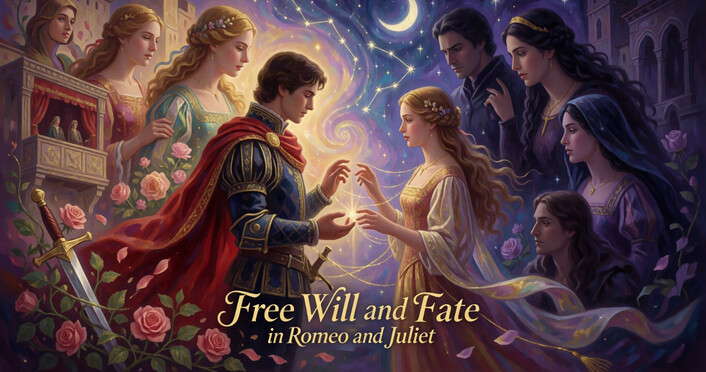
Free Will and Fate in Romeo and Juliet
The human nature follows the path of fate as each and everyone makes different choices in regards to their own free will and this affects their life at that particular time but in the end, it affects their predetermined fate. Fate is one of the important themes that runs across the play and it demonstrates on how Romeo’s and Juliet’s wedding were bound to happen and no one was in a position to change this as it was beyond any human intervention. Free will on the other hand is also another theme that is demonstrated in this play as it illustrates on the notion that Romeo and Juliet’s actions were predetermined by their decisions which were responsible for their emotions. In the beginning of the play, it is stated that, “Romeo and Juliet are star crossed and death marked” (Steele 1). Writers who offer philosophy essay help at Edudorm essay writing service notes that free will is dominant over fate in relation to the two star-crossed lovers and the decisions they took regarding their love. Free will is dominant over fate in relation to the two. Free will is dominant over fate in relation to the two star-crossed lovers and the decisions they took regarding their love. This is proven when Romeo decided to go the Capulet party, how he chose to marry Juliet regardless of the feud, and Juliet marrying Romeo behind her parents’ back.
Romeo all through the play he is seen talking about fate and explaining on how he is a victim of fate. Romeo before going to the Capulet ball he states that, “I fear, too early, for my mind mis-gives, some consequence yet hanging in the stars. Shall bitterly begin his fearful date, with this night’s revels, and expire the term of a despised life closed in my breast, by some vile forfeit of untimely death” (Steele 2). He is thus afraid that something wrong will happen while he is that party as he has this feeling that makes him worried about that night. He is however, having a presentiment that seems to be in relation with the quote and it makes the audience to have a bad feeling too.
Romeo decides to prove his love through extreme measures that includes marrying secretly, Juliet who is the daughter to Romeo’s father worst enemy. Romeo in his remarks he states that, “there is thy gold, worse poison to men’s soul” (Strong 7). He uses this to criticize on the feuding adults between the two families as he regards to this feuding as an act of childishness. Gold in this case is the cause of the grudging action between their parents as it represents wealth as well as jealousy. Despite the fact that they knew that there were consequences that they would face, they went on ahead to marry and the ending was a bad one. The feud therefore is one that goes way back and the rift between the two families was widening and despite all this Romeo and Juliet went on ahead and acted in a disloyal manner towards their families by getting married. Experts who write my essay for me at Edudorm essay writing service indicates that this grudge ultimately resulted to the death of Romeo and Juliet and it is after their death that they came back to their senses and reconciled. However, the feud continued even after their death as they came up with competing golden statues that illustrated that they had not learned anything out of the disobedience of their children that resulted to their death. Though these parental influences came up in the way of Romeo and Juliet, they were able to make their own decisions out of self will that enabled them to conquer these obstacles. Though Juliet is a female and is more constrained as compared to Romeo who is a male and therefore has to fight for his love due to his father’s grudge with Juliet’s parents. It is this action that ultimately results to them meeting at the feast and getting married without either of their parents being aware of this (Cain 189).
Their fathers held feeling of resentment against each other and this caused the unfolding of the story where Romeo and Juliet decided to keep their marriage a secret. They were afraid that their parents would be mad about them getting married following their differences. This is evident as Juliet’s father Lord Capulet and her mother Lady Capulet are angry at her due to her insubordinate conduct, as they she states that, “talk not to me, for I’ll not speak a word. Do as thou wilt, for I have done with thee” (Cain 88). This is evident that her parents are angry at her for marrying Romeo and through the secrecy action; they were avoiding this form of rift between them and their families. It is this secret that also resulted to the death of Juliet and Romeo as the whole plan was made difficult by the fact that the secret about their wedding destroyed their relationship with their families and it also caused a misunderstanding. Thus, if there was no grudge between their parents, they would have informed their parents as they would be sure of their support. However, with this feud, all that they could have expected was more conflict and ultimately restriction of the wedding. They had the support from their wise advisor, Friar Laurence who helped them to keep their secret from their parents as he hoped that the marriage would be contribute towards the ending of the grudge between the two families.
It is thus evident that in all that Romeo and Juliet do in the play is out of their own free will as no one makes them to take the decisions. Rome had an option of not going to the party but he chose to go while they also had an option of not marrying but they chose to marry. Tutors who offer essay writing online at Edudorm essay writing service acknowledges that they also had an option of informing their parents before marrying by they chose not to inform them. Free will is also evident in the manner in which Romeo and Juliet influences others in supporting them in their secrecy about their marriage. Hence, it is also evident that the choice of Friar Lawrence was for the good of the two families and hence the entire society since he declares his devotion to bring reconciliation through this marriage by stating that, “In one respect I’ll thy assistant be, /For this alliance may so happy prove/To turn your households’ rancor to pure love” (Crowther, n.p). Therefore, it is clear that these two characters had options which they could have considered before making their final decisions that influenced their actions. The paths in which they took at the feud, at marriage and at the party were all out of their own accord.
Works Cited
Cain, H. Edward. “‘ROMEO AND JULIET’: A REINTERPRETATION.” The Shakespeare Association Bulletin, vol. 22, no. 4, 1947, pp. 163–192.
Crowther, John, ed. “No Fear Romeo and Juliet.” SparkNotes.com. SparkNotes LLC. 2005. Web. 23 Feb.2 2017.
Steele, R. B. “Fate and Free Will in the Aeneid. In Two Parts—Part II.” The New York Latin Leaflet, vol. 7, no.1164, 1907, pp. 1–3.,
Strong, C. A. “Fate and Free Will.” The Journal of Philosophy, Psychology and Scientific Methods, vol. 15, no. 1, 1918, pp. 5–9.