
Teaching Method for Instructors
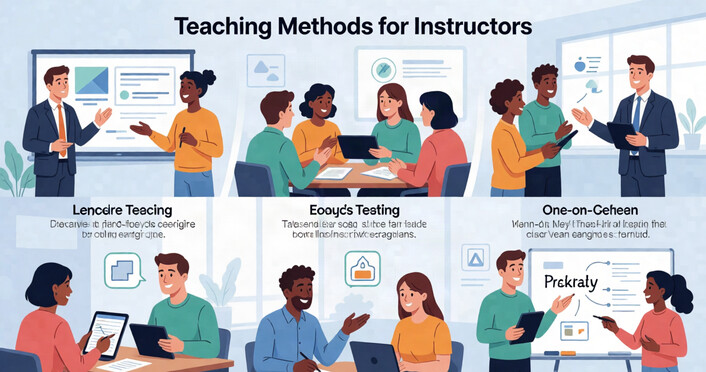
Effective Teaching Method
Effective teaching method creates the foundation of good learning institutions, and an improvement on teachers’ knowledge and skills is among the essential investments that be made in education. Teachers play a very integral role in promoting students understanding if various concepts related to the courses they are undertaking. For active learning to occur, any teacher must facilitate an engaging environment with the students which will allow the students to benefit from the teacher’s instructions and orderly lessons. However, beginning teachers may face challenges relating to confusion and stress coming from their undertaking of new courses that require full participation. Writers who offer research writing help at Edudorm essay writing service notes that effective teachers have to develop meaningful relationships with students which will assist in improving their academics, behavior and high-quality experiences in the classrooms. The instructional teaching method for the teachers should involve making time to communicate with learners so as to ensure direct teacher instruction delivery. Nevertheless, the teaching methods adopted should not limit teachers to classroom talks but should embrace other approaches that cater for diverse learning abilities for the students.
Lecture Discussion Teaching Method
Lecture discussion teaching method is one of the teaching methods that can make it possible for the teachers to create a rapport with his or her students while at the same time facilitating student motivation, enhancing intellectual agility. The strategy also develops democratic environment and habits for students which is necessary in eliminating any tension that could arise among the students because of the new teacher in class. Discussion strategy provides opportunities for learners to practice various skills including an ability to defend and articulate their positions, evaluate listed evidence and put into consideration of the point of view of others (McCown & Snowman, 2014). Opening up a discussion forum also provides avenues where the teacher can explore the character of his students who are leading a discussion or contribution to it. This is because the students will be their real selves, as the discussion are unpredictable and need instructors to surrender their control to an extent over how the information is being offered and its flow. With good planning the beginning teacher can ensure that discussion will be engaging and lively and exploratory without chaos or losing focus. To produce an effective teacher, the skill of planning and steering a discussion for students must be inculcated so as to make it easier for the teacher to develop and grow their students (McCown & Snowman, 2014). This information shows that when discussion is used together with lectures, it facilitates leaning among the beginning teachers. It offers the beginning teacher an opportunity to know how to access the ability of his students and what methods they will use in improving their understanding capability.
Direct Instruction Teaching Method
Direct instruction through a case study is another important strategy that can assist in developing competence in teachers if it is actively used in training courses. Case studies as an instructional approach allow beginning teachers in applying disciplinary analysis methods and in practicing problem solving methods. It enables the learning teacher in practicing cognitive skills of a very higher level in analyzing, synthesizing and evaluation (Jensen, 2010). Experts who offer research paper help at Edudorm essay writing service indicates that an important aspect is that case studies allow the development of professional teachers can blend their critical thinking and effective cognitive dimensions especially in cases that have ethical issues. In addition, the beginning teachers are able to develop and grow their collaborative skills by relating their knowledge to the real world. The overall effect is that these teachers are given the power of formulating various arguments and counterarguments when analyzing the case studies (Jensen, 2010). This professional development will ensure that teachers have a way of directly applying their knowledge to their teaching practice.
Research has shown that professional development based on cases studies results to better instruction and improvement in students learning. In addition, the case studies help the teachers to have a direct focus on the curriculum they will be teaching, and this has been shown to enable them adopt teaching practices instilled in their professional development. Even though case studies are mostly used in business, law and teaching, they can form an effective tool of teaching in various disciplines. When used as an instructional approach, case studies help in bridging the gap between practice and theory, and between the workplace and academy. Effective teachers will be developed through exposures to cases studies on issues that affect students understanding and the acquisition of such knowledge will enable them in determining the best teaching methods in their future practice (Carnegie Mellon University, 2015). When used in teaching classrooms, teachers can help students to identify problem parameters, to recognize and expressive positions, evaluate various courses of action and argue their different viewpoints. In addition, beginning teachers can learn on how to create case studies from their professional experiences, past and current events and historical sources which they will use in teaching and testing their students learning outcomes. In such a scenario, an effective teacher will be able to include important issue in such cases, come up with questions and prompts in advance and even anticipate where his or her students might encounter problems (Jensen, 2010). Good instructors will instil case studies development skills into their beginning teachers who will in turn translate these abilities to their students in class or lecturer rooms.
Cooperative Learning Teaching Method
Cooperative learning as an instructional teaching method is that is normally peer-mediated and one that can be used in the development of beginning staff teaching skills if included as a major aspect in training. Cooperative learning approach is practiced through learning groups where students in these groups are allowed to buy into some targeted outcomes. This approach allows for social interaction whose role in students learning is very crucial since they can be active in creation of knowledge rather than passive recipients of this knowledge. The use of this strategy by teachers’ trainers helps the beginning teachers to learn their role in teaching practice. These teachers learn how to model the communication and social skills that are expected from students which are essential in helping the students to adopt as classroom norms the cooperate planning (Gillies & Boyle, 2010). In this approach, learning tasks and activities and cooperative games are introduced gradually so as to assist the student and the teacher in acquisition of communication skills and small-group organization’s fundamentals. Training teachers on this instructional strategy prepares them to face the discomfort arising from varying levels of uncertainty as to what will be contributed by every group member. This is because of the fact that the teacher has little or no control of the communication taking place at the groups since it is a student-to-student session. In addition, the teacher should be willing to understand and acknowledge the diversity in talents, interests and speed of work among their students (Gillies & Boyle, 2010). Tutors who offer custom research writing service at Edudorm acknowledges that to be effective in delivering instruction and thus knowledge, the teachers must embrace this diversity and try not to treat all students the same way since they have varying learning capabilities. The beginning teachers have to be trained on the need for independent decision making in the classroom in order to strike the right balance among cooperative behaviors, academic goals and skills. Hence, cooperative learning as an approach helps teachers to focus on the development of skills for organization, analyzing and evaluating lessons in regard to their impacts on students learning behavior in academic learning.
An important aspect about cooperative learning is that it is a holistic and integrative outlook of learning which provides a combination of perception, experience, cognition and behavior. The approach has its roots in education philosophy and incorporation of solving social problem and scientific inquiry. It has its basis in personal experience as long as the learners have tools which they can use in observing and analyzing the impacts of experience. The beginning teachers are provided with concrete experience which serves as a catalyst for learning and passing on their skills and knowledge to the students in a classroom environment (Moore, 2009). The learners are given an opportunity to take part in various activities that acts as basis for observation of the entire process and reflection on effects of experience. In the process of instructing and learning, general principles of topic of study form the basis of organizing reflections which are then embedded in generalizations which direct application in emerging situations. Out of this instructional approach, various capabilities are fostered among the beginning teachers: they are able to engage openly with no bias in new experiences; they are able to withdraw from these experiences so that they are detached when observing them and reflecting on why they are important; they can develop logics, conceptual frameworks and theories that brings some orders while observing ; and they can apply these principles in making decisions , solving problems and taking appropriate action (Gillies & Boyle, 2010). While training teachers on how to apply cooperative learning approach, they learn how to integrate various tasks, games and exercises in students’ learning process, interaction with their colleagues and also offers a challenge to their learning, thinking and teaching. In the whole of the training process, teachers are provided with enough opportunity for objective and subjective experience with the cooperative learning, so that they can relate knowledge obtained with real situations in a classroom setting. Trainers also facilitate on how to transit from planning to implementation in classroom or the teachers can rehearse the attained experiences in a workshop which provide a better and safe learning environment. The knowledge and experience attained by the beginning teacher can then be translated in effective classroom delivery since the trained teachers learn how to organize students into groups, facilitate the function of group learning and train the students on how to be an active contributor to the learning process. This enables the students to avoid being passive receivers of knowledge by participating in the learning process. It also enables a social interaction with students, encourages critical thinking among them and acquisition of knowledge through personal relation with peers (Moore, 2009).
Differentiated Instruction Teaching Method
Differentiated instruction is an important teaching method that informs the effectiveness of a teacher in a learning environment since it involves addressing the specific students’ needs. While developing and training beginning teacher, the trainer courses offer information on how to know the learner by continuously creating awareness on the learning needs and strengths of a leaner. This is followed by carrying out an assessment of the readiness and interests of the students and their learning preferences. The teachers are then trained on how to respond to these needs and learning preferences using effective teaching method for providing instruction and assessment (Roberts & Inman, 2007). Through the teaching method, teachers are able to differentiate how learning occurs in students and how it is demonstrated. Differentiation then becomes an organized but flexible way through which teaching and learning can be adjusted to meet the needs of the learners and assist them in achieving maximum growth. The beginning teachers are trained on how to identify diversity in learners in terms of their preferences and reflecting this recognition on the teaching method they adapt. By addressing these issues, students can freely discover creative ways of finding solutions to problems, succeeding and continuing with lifelong learning. The trainers in this case can engage the beginning teachers in examination of the current practice and its effectiveness in entire class instruction and sustaining a classroom culture of differentiated instruction (Roberts & Inman, 2007). In addition, the course developers and trainers should consider how the courses and teaching methods are right now in terms of effectiveness and the extent to which they respond to the needs of learners.
An effective training course will provide beginning teachers with knowledge on how to design and develop instruction, various assessments and evaluations and the learning environment on classroom. These aspects should be based on what is expected on a curriculum and the overall learning needs of the students. Implementation of differentiated instructions has far reached effects on professional development and students’ success which is a collaborative process where success and learning for all is attained. The training courses for teachers should train them on how to use assessment in gathering information about students learning and preferences and their readiness to learn (Moll, 2003). Authors who offer research paper topics at Edudorm essay writing service points that the beginning teachers can then use the information gathered in differentiating instruction, assessments and the learning environment. The teacher can then make a decision on which strategy is best for meeting the needs of the learners as a whole class and embrace learners’ diversity which is common in normal classes. The differentiated instruction allows the teacher as professionals to teach while having the learners’ differences in their minds. It is necessary for them to understand the learners in order so as to be able to come up with appropriate instruction and evaluations that meet the diverse needs of these students (Moll, 2003).
In the differentiated instruction, it is possible to know the readiness of a student to learn specific concepts according to their needs. Tasks can then be differentiated according to their level of readiness, so that tasks can be aligned to the understanding and skill level of the student in terms of a specific topic. An effective teacher should not assume that all learners approach a new concept with similar background knowledge (Moll, 2003). On this note, the beginning teachers may differentiate according to pace, complexity level, learners’ level of independence and quantity of provided learning structure. In addition, it is important for the course content to train teachers on how identify the interests of students as learners so that meaningful and engaging learning opportunities can be planned for. Various ways can be used to determine students interests like the use of surveys, asking questions and endeavoring to link these interests to topics being studied (Moll, 2003). Identifying and attending to the interest of learners improve on learning motivation, since ideas and concepts introduced are relevant to an individual and relevance arises from a connection between student background knowledge and the new information. Preferences refers to the style preferred by the student in acquiring, processing and recalling the new information they are taught. Moreover, assessment can provide information for teachers which will help them in differentiating between learning and teaching activities (Moll, 2003). As effective professionals, teachers should be trained on how to apply information about learners in streamlining and targeting instruction and in provision of feedback to learners to assist in advancing their learning process.
Conclusion
The use of lecture discussion, direction instruction through case studies and differentiated instruction are teaching methods that can be used in the developing training courses for training effective teachers. These teaching methods can also be combined with technology learning through tools like a power point to develop competent teaching staff in a diversified learning environment. For beginning teachers these teaching methods can be very effective in introducing them to the teaching environment since they provide experience on how to focus on cognitive needs of learners and how to respond to them. These instructional approaches also provide a good foundation for developing training courses for beginning and experienced teachers.
References
Jensen, E. (2010). Different brains, different learners: How to reach the hard to reach. Thousand Oaks, Calif: Corwin Press. 9-11
Carnegie Mellon University, (2015). Case Studies. Teaching Excellence & Educational Innovation.
McCown, R., Snowman, J., (2014). Psychology Applied to Teaching. 352-353
Gillies, R. M., & Boyle, M. (2010). Teachers’ reflections on cooperative learning: Issues of implementation. Teaching and teacher Education, 26(4), 933-940.
Moore, K. D. (2009). Effective instructional strategies: From theory to practice. Thousand Oaks, Calif: Sage Publications. 203-203
Roberts, J. L., & Inman, T. F. (2007). Strategies for differentiating instruction: Best practices for the classroom. Waco, TX: Prufrock Press. 5-8
Moll, A. M. (2003). Differentiated instruction guide for inclusive teaching. Port Chester, NY: Dude Pub. 166-168